


The world watches anxiously as Germany redraws its political map. State elections on September 20th showcased a stark dual rejection of the German political establishment. In Berlin, the left-wing party Die Linke (“The Left”) surged to a historic victory, seizing 25.7% of the vote to capture first place in the capital for the first time since the party’s founding in 2007.[1] More concerningly and further north, near Hamburg in Mecklenburg-Western Vorpommern (humorously in English, Pomerania), the far-right Alternative for Germany (AfD) dominated with a majority at 38.2%.[2]
This regional wave washed in with a broader political tide. he AfD had shattered all political ceilings in neighboring Saxony-Anhalt on September 6th, sweeping a staggering 43.8% of the vote and more than doubling its previous share.[3] The simultaneous rise of the radical left and far right expresses electors’ fury over economic contraction, energy shocks, and a stagnant, failing mainstream consensus. It is evidence of a widening crisis of legitimacy the political centre has increasingly failed to contain. The simultaneous rise of the radical left and far right expresses electors’ fury over economic contraction, energy shocks, and a stagnant, failing mainstream consensus. It is evidence of a widening crisis of legitimacy the political centre has increasingly failed to contain.
The war in Ukraine is ominously present in the most recent election results, because the entrenched conflict has fundamentally altered the material conditions of German life. More than four years after Russia’s invasion in February 2022, Germany is being asked to reorganise its economy, its military, its energy system and, increasingly, its conception of security around an indefinite confrontation. Most critically, the war put an end to the era of cheap Russian gas on which much of German industrial production depended, leading to a profound economic crisis.
For many Germans, Ukraine is not a foreign policy question, but one of the price of electricity, heating, factory closures, job security, and taxes sunk into a defence budget.
Before the Nord Stream pipelines were bombed in September 2022, Germany imported more than half of its natural gas from Russia.[4] In August 2025, German investigations reported that the sabotage had been carried out by a Ukrainian cell involving deep-sea divers, military personnel and intelligence operatives. The revelation that infrastructure on which Germany had depended had been sabotaged by personnel linked to an allied state has proved difficult to shake from the German public consciousness.
Now following years of stagnation and contraction, Germany's manufacturing core is bleeding out. The heavy machinery, chemical plants, and metalworks that formed the bedrock of the German economic miracle (Wirtschaftswunder) in the post-2022 era have been in a slow-motion collapse. As a result, German domestic politics resist the easy categorization the Western media tends towards, especially regarding the increasingly explicit fascism of Alternative fur Deutschland. UK SNL collectively lambasted the election results, suggesting the AfD is hardly 'much of “an alternative” for Germany but rather “an old classic” for Germany. But writing off the German electorate risks missing the point: motives regarding war, migration, and economic survival are no longer separate issues.
The geography of Sunday’s election results bears a closer look. Mecklenburg-Vorpommern is former East Germany. Geographically close to the Baltic, the politics of the region reflect a combination of economic stagnation, post-reunification resentment, and historically, a closer relationship with the USSR. Immediately after the result, the Kremlin made a statement that Germany's decision to abandon cheap Russian gas had damaged its competitiveness and contributed to the AfD's electoral success. “East Germany” has been at odds with Christian Democratic mainstream of West German politics for more than a century.
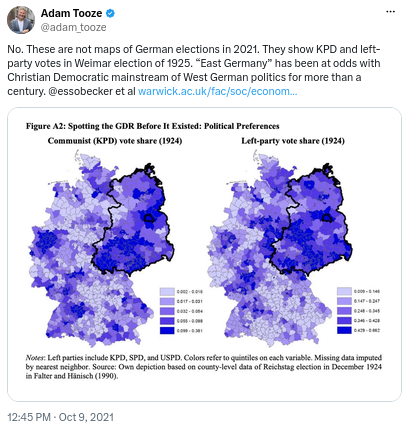
Both winning parties in Sunday’s elections are, notably, critical of the German government's military support for Ukraine, though they arrive at that position from different political traditions. Die Linke condemns Russia's invasion and explicitly recognises Ukraine's right to self-defence, but opposes further weapons deliveries and argues for diplomacy and negotiations. The AfD has called for an end to German support for Ukraine and advocated a negotiated settlement.
It would be misleading to place Die Linke and the AfD in the same category simply because both oppose German weapons deliveries. The radical left and far right parties arrive at this position from diametrically opposed premises.
But on the question of German militarisation and the war, there is a common rejection of the mainstream assumption that the answer to Russia is simply more German military involvement. In Mecklenburg-Western Pomerania, the CDU, Angela Merkel's old party and now the party of Chancellor Friedrich Merz, received only 4.9%, falling below the threshold required for parliamentary representation.
This is understandably humiliating for the German political centre.
The centre’s decline in recent years has featured the humiliating collapse of the centre-left SPD under Olaf Scholz, before Friedrich Merz and the CDU took center stage promising competence, growth, security and a harder line on migration, only to make no notable progress on any of these objectives. Instead of addressing these foundational cracks at home, Germany has continued to tie its foreign policy ever-more-closely to the United States and NATO.
Compounding this political paralysis is a security crisis that has devastated any sense of public safety. The country has seen a succession of high-profile attacks in Mannheim, Solingen, Magdeburg, Aschaffenburg, Munich and, most recently, at Berlin's Christopher Street Day gay pride parade, when a vehicle was driven into people near the CSD celebrations, killing one person and injuring 29. Investigators identified the suspect as a German national born and raised in Berlin who had previously come to the attention of security authorities over Islamist activity.
Politically, the distinction between immigration and terrorism does not survive contact with massive public fear. Migration became the dominant issue of the 2025 federal election campaign, particularly after the Magdeburg Christmas-market attack. By January 2025, 37% of Germans named migration and asylum among their two most important political problems. In February, that figure reached 42%.
These issues distill a larger question for Germans beyond party lines: what kind of country is Germany supposed to be? One that buys American energy, rebuilds its military and accepts the economic costs of severing with Russia? Or a version of the old European model involving cheap energy, industry, social welfare, trade and accommodation? Just that the old model depended on conditions that no longer exist. Meanwhile, telling an economically hollowed-out public to embrace a new age of military confrontation is a catastrophic misread of the national mood.
This is why the AfD's rise cannot be understood solely through immigration. Its message effectively combines xenophobia critique of Germany's economic and foreign-policy establishment. Its proposal to revive Russian energy supplies is provocative for those who can see no way out via the status quo.
History teaches us that xenophobia is never only about the foreigner, but scapegoating. Fascism was always about scapegoating, about using migrants and minorities to divert attention away from poverty and systemic crisis. This was precisely the case with the rise of Hitler, in interwar Germany, as the dark legacy of World War I, a catastrophic class war where the ruling elite sent the working poor to slaughter simply to preserve their own wealth, ultimately fueling the October Revolution.
Die Linke offered an actual “alternative” to that historical cascade to fascism. Its Berlin campaign offered a very different diagnosis for the crisis from the AfD: the system is failing because of a class conflict, and rent exploitation. These are two movements reacting to the same political condition while offering radically different explanations of its causes and, consequently, radically different solutions. That condition is insecurity.
The question, then, is whether the insecurity Germans are being asked to endure is tenable, and what Germany is willing to sacrifice in order to pursue the war. Funny memes emerged recently in reaction to Paneuropean Union President Karl von Habsburg calling for a coalition to intervene against Russia, and for the dismantling of the Russian Federation. There are sentences history ought not repeat. “Habsburg calls for war against Russia” is one of them. Are we in August 1914?
In 2018 I took part in a cycle protest as volunteer media against subsidies for the arms industry during the war in Syria, organized by the German Peace Society (Deutsche friedensgesellschaft, who knew such a thing existed, but it does, since 1895). The protest was largely made up of older, boomer hippie Germans. In video interviews, participants expressed their extreme disgust with the war machine. “It provokes indescribable shame,” one older man said. Boomer after boomerdescribed the psychological and physical trauma their parents had suffered as children and young adults during the war, growing up in starvation, without one or both their parents, wounds that continued throughout their lives. For them, opposition to war was not an abstract political position.
At the end of this jaunt to Berlin in August, my five-year-old daughter and I took a cycle ride and managed to get lost in a central Friedhof (cemetary). We proceeded further and further into untended graves, consumed by overgrowth, until we found a compound at the back with no exit. There, row after row of headstones lay flat on the ground, marking the dead of 1945, presumably those who died during the Soviet invasion and liberation of Germany’s capital.
As the generations of Germans and Europeans scarred by war now die out, will Germany and the rest of the world, remember their lessons?
Andalou Agency via Reuters, “Left Party wins Berlin state election with 25.7%”, 2026. ↩︎
Oliver Denzer and James Mackenzie, “AfD leads as Merz rues 'disaster' in worst state election result in postwar Germany”, Reuters, 2026. ↩︎
Geir Moulson & Kerstin Sopke, “Far-right Alternative for Germany party wins big in regional election but falls short of majority”, Associated Press, 2026. ↩︎
John O'Donnell, “Putin envoy and far-right AfD prepare talks to get Russian gas back for Germany, sources say”, Reuters, 2026. ↩︎


