


As sabres rattle over Iran, Ukraine, and Russia, several billion people redirect their attention to twenty men chasing a ball. Since Roman times, the poet Juvenal complained that the public had exchanged republican citizenship for panem et circenses—bread and circuses.[1] The creeping inkling that mass sporting spectacles primarily function as political distraction has never entirely disappeared.

But it’s more complex than that though, isn’t it—there’s the sheer joy of the football pitch, the sweet escape from politics and simultaneously a screen onto which we can project our geopolitical anxieties. Things have felt oddly calm since the World Cup began, but perhaps only because ninety minutes of football can drown out almost anything: Trump's comments on the Strait of Hormuz and his proposed toll on global shipping; the latest killings by ICE enforcement, Lorenzo Salgado Araujo, a 52-year-old builder, and Johan Sebastián Guerrero, 26, who held a permit to work in the U.S.
George Orwell famously wrote that sport is "war minus the shooting."[2] While we like to imagine international football as a beautiful, civilized way to channel toxic nationalism into harmless theater, Orwell suggested it could just as easily be fueled by "hatred, jealousy, boastfulness, disregard of all rules and sadistic pleasure in witnessing violence."
This World Cup final gestured in that direction, in moments appearing on the verge of degenerating into a bar fight. Spain and Argentina traded a staggering 16 and 20 fouls respectively, with Argentina collecting four yellow cards and a red card.
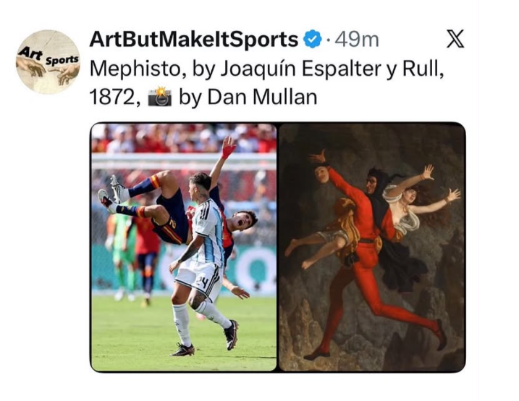
Naturally, the illusion of athletic purity vanished weeks ago when Donald Trump treated the FIFA rulebook like a real estate negotiation, lobbying to get a U.S. red card overturned. But football as a geopolitical smokescreen is a time-honored tradition.
England v. Argentina in the semi-finals was forever going to be loaded with the ghosts of the Falklands/Malvinas War of the 1980s. Who (certainly not the Argentinians) could forget Margaret Thatcher’s brutal sinking of the General Belgrano, killing over 300 Argentine sailors in 1982? When they met on the pitch in 1986, just four years later, it wasn't a sports game; it was symbolically, Las Malvinas son Argentinas.
It was with all the greater pleasure that Argentina and the world watched the sweet cokehead Maradona score not one, but two goals: one, largely regarded as the goal of the century, when he barreled up the pitch, driving the ball, alone, sinking it into the net; the other, notorious, remembered as the "Hand of God", a punching-goal that would never get past today's VAR.
The moment was elevated from mere match to global catharsis.
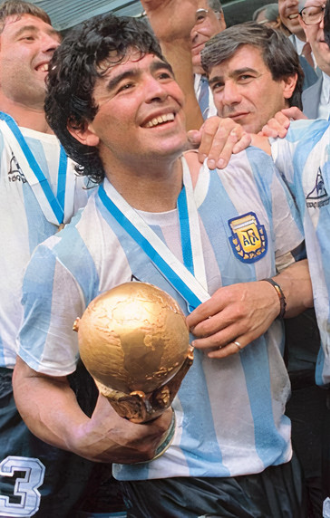
1986 was less a sporting event, more geopolitical catharsis. To watch England be cheated by a diminutive genius from the slums of Buenos Aires was strangely intoxicating. It was a subversion of the global hierarchy; ninety minutes, in which the asymmetric warfare of the real world was turned upside down.
Peasant Brawls and Betting Slips
The scene on the pitch at full time on Sunday, after Spain won: Argentina’s Nahuel Molina threw punches at Spain’s captain Rodri, leading to a general scuffle. It’s giving seventeenth-century peasants brawling in a muddy field over dregs—the riches are happening elsewhere, or the rich are betting on the peasants brawling.
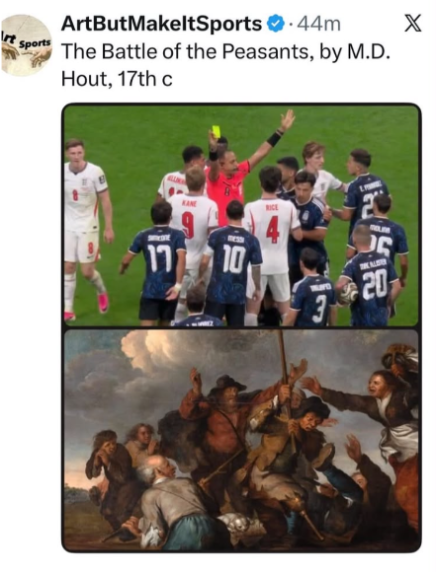
Nowhere has this peasant mud battle/circus vibe been more obvious than in this year’s NAFTA-hosted tournament. The game was aggressively retrofitted for monetization, feat. mandatory three-minute "water breaks" meant to serve as extra windows for advertising revenue.
Even the most ardent fans will admit modern football has become increasingly difficult to separate from the gambling industry. This financial entanglement alters how we experience the game's inherent drama.
Modern football is now so tied up with betting apps that dramatic developments on the pitch feel like algorithmic execution. Consider Argentina's uncanny habit of surviving until the ninety-third minute to rescue a result, in most of their games this world cup. OK, football is chaotic and improbable. But the fifth miraculous late intervention that simultaneously detonates millions of betting slips worldwide, could cause you to wonder.
As Honoré de Balzac famously wrote, "Behind every great fortune lies a great crime."[3] It’s impossible to look at modern sports without seeing the great fortune. The tragedy or crime therein is that our collective passions, solidarity, and joy are being systematically harvested by corporations, FIFA, and betting syndicates.
Protestant Football vs. The Hand of God
The cosmic joke of international football is its dual identity: it is simultaneously a vehicle for global solidarity and a high-stakes outlet for toxic nationalism.
Even as we speculate whether the game is rigged, we still look for something greater—even, the divine—to intervene on the pitch. One theory currently circulating is that Brazilian football’s decline is due to the abandonment of traditional Catholicism for imported U.S. evangelicalism.[4] England continues to suffer the rigid, agonizing limitations of 'Protestant football'—though they did briefly suspend their existential dread to thrash France in the third-place match. Argentina, protected as always by the secular sainthood of Maradona's Hand of God, somehow survived again to the final of the tournament.
But miracles have their limits, and even the Almighty eventually draws a line. God may have indulged Diego Maradona's cheeky handball in 1986, but even He (She?) could never back Javier Milei. Seeing certain Argentine fans wave Israeli flags to honor Milei’s trade deals with Israel, at the Egypt game, and Milei’s chainsaw economics/ hyper-neoliberalism in general could have been too much a test of even the most forgiving God's patience.
If providence has any political preferences left this year, they were always going to favor Spain. Spain's current left-leaning coalition has been among Europe's strongest voices for recognizing Palestinian statehood and upholding international law.
Look no further than New York City: they elected their first democratic socialist mayor, Zohran Mamdani, and the Knicks win their first NBA Championship in 53 years. Democratic socialism broke a half-century curse in Madison Square Garden, and now it has delivered the World Cup.
Is the God of Sport smiling toward the Left?


