


The actions of an unidentified Iranian woman, now known online as the “science and research girl,” have reignited a fierce debate about state control and personal freedoms in Iran. On November 2, 2024, video footage captured her walking in her underwear outside Azad University in Tehran, an act that followed an alleged confrontation with university security over her attire, reportedly deemed “insufficiently Islamic.” Soon after, a second video emerged showing security personnel escorting her to a vehicle, with authorities later stating she was admitted to a psychiatric facility due to “psychological disorders.” This explanation has raised eyebrows, as previous cases suggest that psychiatric confinement has been a tactic used against women who defy the state.[1]
For many Iranians, she is more than another dissenter; she’s a symbol of broader resistance against restrictive dress codes and state intrusion. Since Mahsa (Jina) Amini’s death in 2022, symbolized by the Woman, Life, Freedom movement, the headscarf has once again become a powerful and contested symbol. Women who defy these laws face arrest and other punishments, risking their freedom for the right to self-expression. The incident highlights a growing divide between the state’s rigid control and the Iranian public’s demand for autonomy.
The impact of this struggle extends well beyond Iran’s borders. In the Iranian diaspora, this woman’s defiance resonates deeply, touching layers of memory and trauma that have accumulated over generations. The struggles of Iranians at home, including those of ethnic minorities like Amini, are often reinterpreted in ways that flatten their depth, cast through the lens of white liberal feminism or Orientalist narratives that treat Muslim women as symbols rather than individuals. These interpretations, frequently driven by external agendas, ignore the unique challenges within Iran, simplifying complex realities into talking points that serve larger political narratives.
Within the diaspora, these tensions fuel networks of nostalgia and estrangement, creating what the sociologist Pierre Bourdieu might describe as a “spontaneous sociology” of shared understandings.[2] This collective disposition influences emotional and financial support as well as the diaspora’s advocacy on issues that touch foreign policy. The community, through its solidarity and its fissures, reflects and refracts Iran’s turbulent present, showing us that exile can both preserve and distort what it means to belong.
Beyond Diaspora
The word “diaspora” circulates so freely today that it sometimes loses its analytic power. The sociologist Rogers Brubaker describes a “diaspora diaspora,” suggesting that the term has been stretched so far that it may no longer capture what is unique about the immigrant experience.[3] Scholars like Evelyn Hu-DeHart argue that this looseness robs the concept of the precision needed to analyze how immigrant communities actually live and organize across borders.[4]
This matters because the way we name a community determines what we can see within it. Call Iranian migrants in France a “diaspora” and the term encourages a picture of a unified group, bound by shared loss and oriented toward a common homeland. That picture obscures the fractures that actually define the community: between monarchists who idealize pre-revolutionary Iran and progressives who once championed Enlightenment reform, between those who arrived as students in the 1940s and those who fled after 1979, between secular intellectuals and religious conservatives. These fractures matter because they determine how different segments of the community respond to events like the “science and research girl” incident, how they allocate financial and emotional support, and how they engage with foreign policy. Traditional classifications like “ethno-national diaspora” or “conflict-generated diaspora” assign fixed identities, flattening the very distinctions that make the community politically legible.
Iranian migrants often form what Maarten A. Hajer calls “discourse coalitions,” networks bound not by shared ethnicity or religion but by shared narratives.[5] When Iranian migrants identify as part of a diaspora, they tap into these narrative coalitions. Even when their reasons for migration differ, their stories intertwine, forming unconventional alliances centered on the struggles and ideals they carry with them. Nostalgia in these communities creates intricate webs of resentment and longing that cross generations. The yearning for a homeland, an Iran that may not even exist in reality, generates powerful collective memories that determine everything from how Iranians abroad advocate for change to how they understand their own political commitments.
The Iranian Community in France
Iranian migrants to France didn’t arrive as a cohesive group with a singular purpose; they were students, intellectuals, political dissidents, and ordinary people from vastly different backgrounds. Each brought their own hopes, struggles, and versions of “Iran,” creating a community at once united and divided by memory, ideology, and experience. Unlike traditional labor migration, early waves came from intellectual and middle-class backgrounds. Many were students and professionals who saw France as a place to grow intellectually while staying connected to their heritage.[6]
Throughout the twentieth century, successive waves of migration created a layered community. The Iranian population in France spans political affiliations and religious beliefs, with members aligning with leftist groups like the Tudeh Party or the Mujahedin-e Khalq, and others supporting the monarchy. Early migrants were often intellectual “exiles of knowledge,” whereas later waves included politically motivated individuals escaping repression. Over time, these groups created their own networks, each carrying different memories of Iran and visions of what it should become. One common thread persisted across these differences: a strong sense of cultural pride combined with a desire for integration. Many Iranians in France describe themselves as well-assimilated citizens who have contributed meaningfully to French society, celebrating their Iranian heritage and embracing the French ideals of republicanism and social responsibility.
Estimates of the Iranian population in France vary widely, with figures ranging from 24,000 to 26,000 and possibly higher.[7] These numbers may seem modest, and the community’s influence has always extended beyond them. Many Iranians in France came as intellectuals, artists, and political exiles, bringing cultural contributions that have left a lasting mark on French society. This community includes high-profile figures such as former Iranian President Abolhassan Bani Sadr and leaders of the Mujahedin-e Khalq. Many have also struggled with underemployment, facing barriers that limit professional opportunities despite high levels of education. Even so, they emphasize their successful integration, highlighting that being Iranian in France means finding ways to thrive and give back: small in numbers, rich in cultural and intellectual influence.
The longing for “home” does not necessarily translate into a desire to return. Many Iranians in France describe a sense of placelessness that is both familiar and foreign, captured by the Persian phrase kharej az keshvar. Literally “out of the country,” the phrase resonates as a feeling of being perpetually outside of a homeland that only exists in memory. Iranian identity abroad is less a fixed inheritance than an evolving process, constantly rewritten by both memory and the experience of life in France. In their efforts to preserve a sense of belonging, many Iranian migrants find themselves creating imagined versions of Iran, drawing from nostalgic memories that may never have been real. This longing inflects everything from cultural production to political engagement.
A Legacy of Activism
For Iranians who moved to France, especially the students who came after World War II, the country became a place to imagine a future for Iran. In 1948, Iranian students founded the Association des étudiants iraniens en France (AEIF) in Paris, setting out to introduce Iranian culture to the French and to build connections among themselves. Their mission quickly took on a political edge. At a time when both France and Iran were grappling with profound social and political shifts, these students saw France as a partner in their struggle for progress back home.
The AEIF was dissolved in 1952 after French authorities, suspicious of its leftist leanings, expelled one of its leaders. The spirit of the organization endured, capturing the political ambitions of Iranian students in France. Their bulletins, featuring literature, cinema, and Persian poetry, were filled with revolutionary ideals. France was not just a country for them; it was a symbol of liberation and a model for change.
The AEIF’s bulletin also served as a platform for outside intellectuals. Among them was Ehsan Naraghi, a young Iranian studying in Switzerland, whose lecture on French cultural influence in Iran was published in the bulletin’s pages. Naraghi portrayed France as a liberating force in Iranian history, suggesting that revolutionary ideas from France had inspired the Iranian Constitutional Revolution of the early twentieth century. His vision traced Iran’s political awakening back to France’s influence, connecting Amir Kabir’s reforms in the nineteenth century and the establishment of Tehran’s Dar ul-Funun to French educational ideals. By linking Iranian and French revolutionary principles, Naraghi created a powerful narrative of kinship, casting Iran’s political future as inherently intertwined with the values of 1789.[8]
Naraghi’s intellectual trajectory, however, reveals not a hidden continuity but a dramatic reversal. In December 1948, while studying in Switzerland, he delivered a lecture at Combloux championing the French Enlightenment’s liberating influence on Iran, tracing how Montesquieu, Rousseau, and constitutional ideals helped Iranian culture break free from religious “paralysis” and feudal constraints. At this moment, French culture appeared not as corrupting Westoxification but as a catalyst for democratic reform that resonated with Iran’s own constitutional heritage. This early engagement with Enlightenment rationalism proved less a blueprint than a phase he would actively betray. Though involved with the Tudeh Party and communist organizations from the mid-1940s through at least 1951, Naraghi underwent a profound ideological transformation in the following years, emerging by the 1960s as a central figure in the Pahlavi technocracy: director of the Institute for Social Studies and Research, advisor to Farah Pahlavi, and close associate of senior SAVAK officials. The democratic ideals glimpsed in his 1948 lecture, where he celebrated French realism for liberating Iranian art from religious constraints, gave way to a militant anti-modernism that denounced the very Western influences he once praised as essential to Iran’s cultural renewal. What appeared in 1948 as an open embrace of Enlightenment modernity became, by the 1970s, a mode of institutional complicity in an authoritarian system dedicated to extirpating those early ideals.[9]
Monarchist Nostalgia Abroad
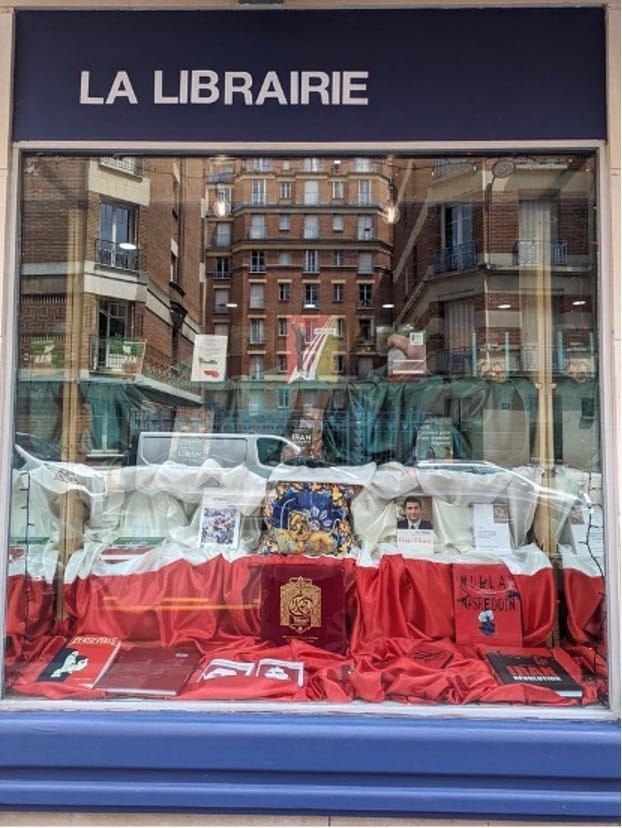
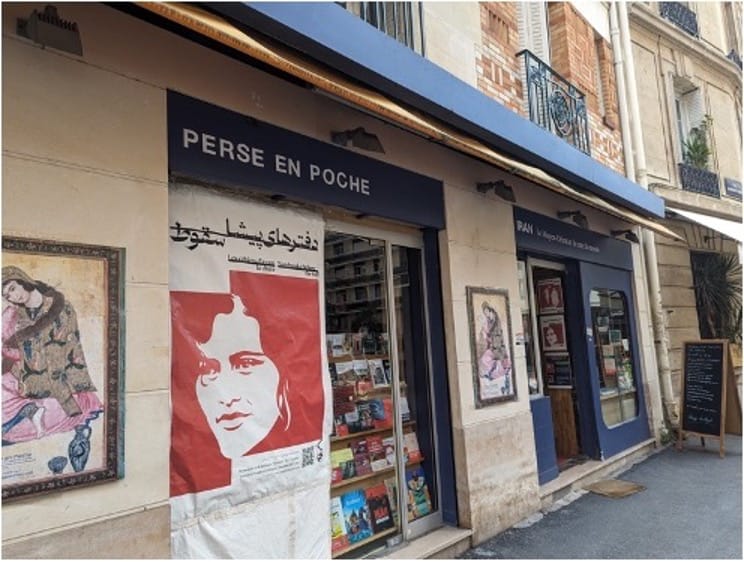
Not all Iranian migrants to France gravitated toward progressive ideals. Many held tightly to memories of pre-revolutionary Iran, longing for a return to what they saw as a lost golden age. This longing is most visible among monarchists, Iranians who continue to revere the Pahlavi era and its symbols. Places like the bookstore Utopiran Naakojaa, adorned with the Lion and Sun flag, have become nostalgic sanctuaries. Here, the monarchist community publishes Les cahiers d’avant la chute (“Notebooks Before the Fall”), a publication that recalls the era before the 1979 Islamic Revolution as a time of dignity and freedom.
One of its contributors, Hossein Abkenar, speaks to this sentiment directly. In his articles, he highlights human rights abuses by the current Iranian regime and frames them within a narrative that idealizes pre-Islamic Persia. His writing draws on imagery that paints Islam as an alien imposition on Iran’s identity, an intrusion that many monarchists blame for the country’s current struggles. For Abkenar and those who share his views, the Iranian monarchy represents a cultural identity rooted in a time before “Islamic violence,” as he controversially phrases it.[10] Where Naraghi’s early writings looked forward, casting Iran’s future in the language of French Enlightenment reform, Abkenar’s prose looks backward, locating Iranian authenticity in a pre-Islamic past that precedes the very civilization Naraghi once celebrated. Both visions emerge from exile, and both construct an Iran that exists largely outside of time, each one erasing what the other most values.
Sociologist Hamid Naficy describes nostalgia in the Iranian diaspora as a source of both comfort and tension, where the longing for an unattainable past reinforces a sense of loss.[11] It sets monarchists apart within the broader Iranian community in France. Their vision of Iran exists outside of time, a dream of what they believe the country could become if freed from its current constraints. And when memories are idealized to this extent, reality often falls short, creating a longing that can never be fully satisfied. The yearning for a lost Iran deepens divisions, fostering a collective sensibility built more on opposition to the present regime than on any shared vision for the future.
Nostalgia and Its Futures
Naraghi’s reversal and Abkenar’s backward gaze illustrate what Bourdieu might call a spontaneous sociology within the diaspora: a way of understanding the world, collectively produced and collectively inhabited, that is forged from shared grief, historical grievances, and competing visions of the nation. Nostalgia here doesn’t simply recall the past; it actively determines how Iranians abroad see their present and future, how they allocate emotional and financial support, and how they understand foreign policy. Even as these groups disagree on Iran’s past and future, they find common ground in their sense of loss and their sense of exile. This spontaneous sociology guides the community’s collective actions, informing both its resilience and its fractures.
This is why the “diaspora diaspora” matters. The very concept of diaspora, applied without precision, obscures the competing nostalgias and ideological commitments that structure the community from within. The “science and research girl” becomes a different figure depending on which segment of the diaspora receives her image: a confirmation of clerical barbarism for the monarchist, a vindication of feminist resistance for the progressive, a source of Orientalist spectacle for the Western observer. Each reading draws on a different reservoir of memory and political commitment, and each produces a different set of political consequences. The Iranian community in France does not respond to such events as a single body. It responds through its fissures.
Scholars have increasingly called for moving beyond the traditional diaspora framework, arguing that viewing migrant communities solely through the lens of a nostalgic “lost homeland” is limiting. The sociologist Thomas Faist argues that transnational studies open up a broader view, seeing identity as a series of ongoing negotiations rather than a static state.[12] This approach shifts the focus from roots to routes, emphasizing movement and the networks that form across borders. For the Iranian community in France, this means acknowledging the memories that bind them while also embracing the new identities they create along the way.
As generations grow and change, the community continues to redefine itself. Younger Iranians, born abroad or who left Iran at a young age, often feel a connection to an Iran they’ve only known through family stories and community gatherings. For them, Iranian identity is about exploring the heritage they’ve inherited, finding their own ways to honor it, question it, and make it new. The Iranian diaspora in France has weathered political upheavals and cultural shifts, and it endures, reshaping itself in response to each new moment. Iranians in France carry a legacy of activism and cultural pride that bridges continents and connects generations, a story of belonging reimagined with each new chapter.
Ghazal Golshiri, “Iranian Woman Who Stripped Becomes Symbol of Struggle against the Obligation to Wear a Headscarf”, Le Monde, November 5, 2024. ↩︎
Pierre Bourdieu, “Social Space and Symbolic Power,” Sociological Theory 7, no. 1 (1989): 14–25. ↩︎
Rogers Brubaker, “The ‘Diaspora’ Diaspora,” Ethnic and Racial Studies 28, no. 1 (January 2005): 1–19. ↩︎
Evelyn Hu-DeHart, “The Future of ‘Diaspora’ in Diaspora Studies: Has the Word Run Its Course?,” Verge: Studies in Global Asias 1, no. 1 (2015): 42. ↩︎
Maarten A. Hajer, The Politics of Environmental Discourse: Ecological Modernization and the Policy Process (Clarendon Press and Oxford University Press, 1995), 13. For more on “unconventional political coalitions,” see Sidney G. Tarrow, Power in Movement: Social Movements and Contentious Politics, Rev. 3rd ed., Cambridge Studies in Comparative Politics (Cambridge University Press, 2011), 95–118. ↩︎
Laetitia Nanquette, “Diaspora and Literary Production: Iranians in France,” in The Iranian Diaspora: Challenges, Negotiations, and Transformations, ed. Mohsen Mostafavi Mobasher (University of Texas Press, 2018), 179. ↩︎
Nader Vahabi, “Genèse de la diaspora iranienne en France. Une analyse sociohistorique,” Migrations Société 139, no. 1 (2012): 27–45. ↩︎
Ehsan Naraghi, “Influence de la culture française en Iran” in Association des étudiants iraniens en France (Bulletin), June/July 1949, pp. 2-7, Bibliothèque nationale de France, 4-JO-6680, Paris. ↩︎
Ali Mirsepassi, “Ehsan Naraghi: Chronicle of a Man for All Seasons,” in Iran’s Quiet Revolution: The Downfall of the Pahlavi State, The Global Middle East 9 (Cambridge University Press, 2019), 58–106. ↩︎
Hossein Abkenar, “La violence islamique : pourquoi êtes-vous tous abasourdis par cette violence ?,” Les cahiers d’avant la chute: Revue d’idées et de littérature, no. 1 (November 2022): 30. ↩︎
Hamid Naficy, “The Poetics and Practice of Iranian Nostalgia in Exile,” Diaspora: A Journal of Transnational Studies 1, no. 3 (1991): 285–302. ↩︎
Thomas Faist, “Diaspora and Transnationalism: What Kind of Dance Partners?,” in Diaspora and Transnationalism: Concepts, Theories and Methods, ed. Rainer Bauböck and Thomas Faist (Amsterdam: Amsterdam University Press, 2010), 9–34. ↩︎


