


It takes one hour and thirty-five minutes to travel from the coast of Connecticut to the pits of Hell. Pop in a podcast of your choice in your car’s bluetooth for the journey and you can watch as the idyllic homes and apartments nestled in the forested shores of the Nutmeg State slowly transform into a prison at the edge of the world. The Delaney Hall Immigration Detention Facility is nestled at the mouth of Newark Bay, beside a state detention center to its north and nearly parallel in latitude to Ellis Island in the east. The New York City skyline is visible from the industrial strip where it resides, standing a certain way on the street, you can see the Freedom Tower on your right and the prison on your left. Privately owned by the GEO Group, a for-profit prison company, it is one of two immigration detention facilities currently holding alleged undocumented immigrants in New Jersey.
In September, you could smell it before you saw it; the brackish water, the diesel, the bitumen, and the human waste of all types. The latter is courtesy of an intermittent train carrying boxcars and boxcars of trash on its way to a nearby garbage dump towards the south, where a strong enough wind or a jolt in the tracks causes a hail of refuse to spill out onto the road parallel to the facility. If you decide to park your car on the street, you’ll have to be careful where you step, lest some old toilet paper get stuck to the bottom of your shoe.
The compound itself has a sort of stark mundanity to it; its walls are composed of bleak and gray stones interrupted by blacked out windows. There’s no way to get a closer inspection of them– you can only go as far as a section of the parking lot before being hindered by the tall chain link wraps around the prison. Bronze letters spelling out “Delaney Hall” hang above the front entrance in a typical American high school font. Formerly a defunct for-profit prison, the 1,000 bed facility had reopened in May of 2025, after the GEO Group signed a fifteen year, $1 billion dollar contract with U.S. Immigration and Customs Enforcement to now exclusively process and house immigrant detainees. The prison’s repurposing was a piece of the re-elected Trump Administration’s greater plan to deliver on the most widely spouted campaign promises; to deport over a million migrants by any means necessary.
Despite the lonely journey to Newark, I’d not come here on my own. Fellow members of New Personalist Movement, the left-wing Catholic group that I help organize, were already present. Primarily based in New York City, the New Personalists had formed a year prior under the banner of leftist “Personalism”, a belief that emphasizes the inherent dignity and unique value of each human person. From these intellectual roots, we hoped to spread both Christian opposition to state violence and capital and advocacy for the marginalized of society. The rights of immigrants had always been a priority, and we’d resolved to assist those targeted by the regime in whatever way we could. A fellow group of Catholics, Pax Christi, had established a daily mutual aid tent for the worried family members of those imprisoned, with a rotating roster of faith groups coming to assist them. We were one such group.
The collective effort was immediately evident; upon the tables rested everything from food and coffee to toys and games for the children. The station underneath the main tent held icons of Fr. Daniel Berrigan and the Madonna and Child atop a kufiya, an assortment of prayer cards and rosaries for the taking in front of them. Beyond our little station loitered dozens of worried families in the tiny cracked parking lot, all waiting for their name to be called by a warden so that they may enter through the gates and visit a loved one imprisoned inside.
More trickled in as the hours ticked on, a few stopping to borrow the donated hats and mittens we’d organized before joining the somber fray. They were mothers and fathers, daughters and sons, aunts, uncles, nieces, nephews, grandparents. Some were as old as 70, others as young as 5. Some stood on the asphalt, bracing the cold with their hands in their jacket pockets and downcast eyes, while others sat in the chairs Pax Christi had set up for them and chatted. Neither GEO Group nor ICE had bothered to build any structure for these families to wait inside or seating for them to rest on, an unspoken yet loud punishment for being associated with anyone who’d allegedly dared to set foot on this nation's soil without the proper paperwork.
From his station at the gates of the fence, a portly guard barked at us to put our phones away. I’d brought my Canon camera, but a hushed warning from the other Good Samaritans about the guard threatening to shut the entire operation down prompted me to quietly slip it back into my backpack and tuck it behind the makeshift booth. A couple hours later, another friend, a freelance photographer, came to the facility in the hopes of documenting its horrors.
“Is it okay if I leave my equipment in your car for a bit?” He asked me.
“Yeah,” I said. “But I gotta let you know, they’ve threatened to shut down visiting hours for everyone if they’re photographed.”
“Bastards.” He replied. “Not surprised they’d sink so low.”
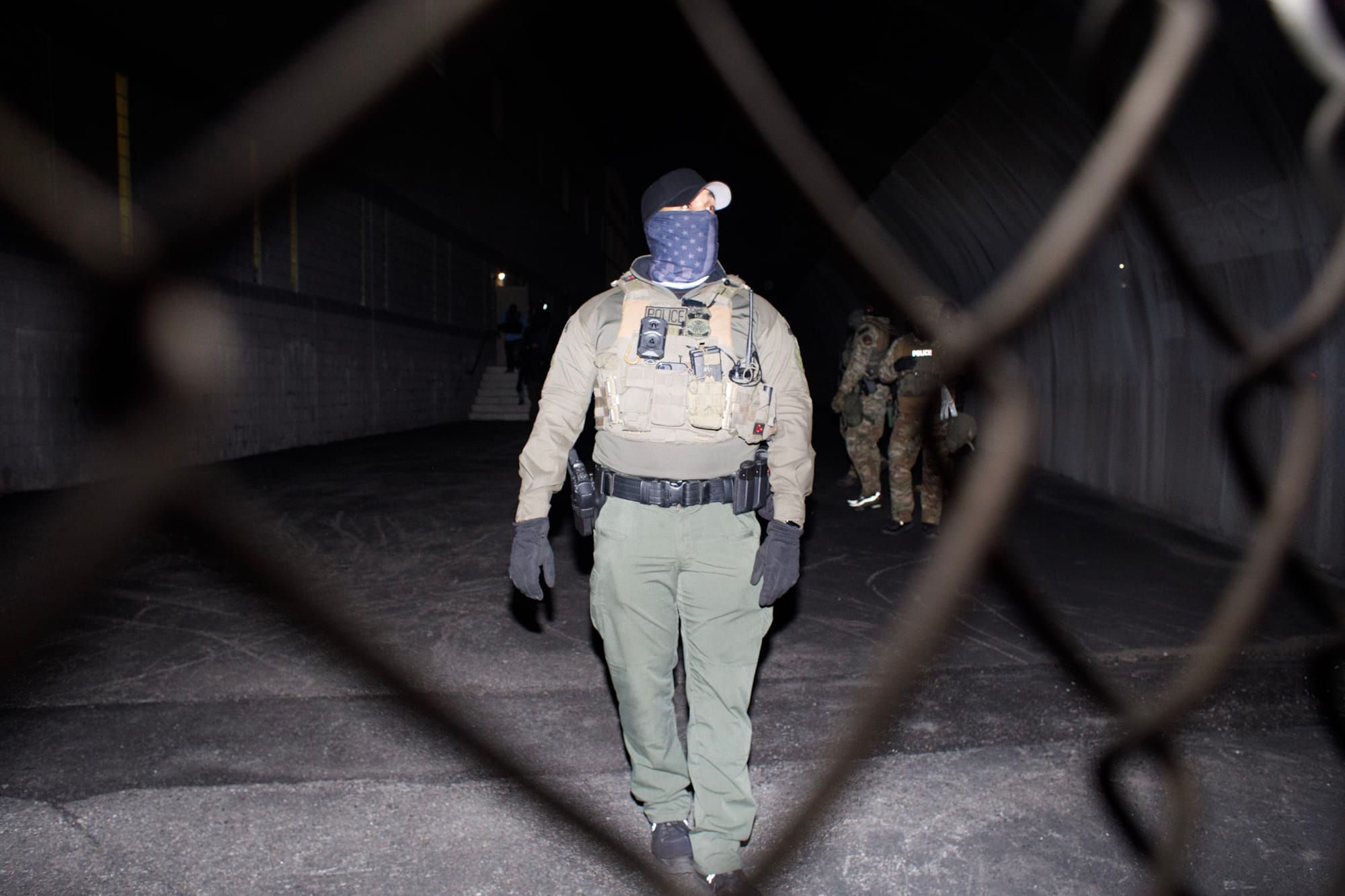
The man paced back and forth in front of those gates throughout his shift with a perpetual scowl and a certain meanness of someone who was sick of the day turning his voice razor sharp. He’d look at us occasionally, though waiting for an opportunity to wield his weapon on the people he had power to punish. I wondered about that guard; his routine, if he got out of bed every morning, shaved, dressed, and went to work filled with a dread of a typical American morning commute, rather than what he was doing to people every day.
A similar thought crossed my mind when another guard finished his shift and drove out of the prison gates with a rosary hanging on the rearview mirror of his oversized Ram truck. I watched him, fingering the bead of my own rosary tucked in my pocket and mused how two people who supposedly worshipped the same God could end up on such radically opposite sides of a moral issue.
“How could someone work at a place like this?” I wondered out loud to a Pax Christi member as we stood on the street before the facility, holding up signs with anti-ICE slogans to the honking horns of passing cars. “They must be thinking: ‘Well, the money’s good, it's a living that puts food on the table. That’s how they stomach it, that they gotta live and that they’re just doing a job.’”
“And maybe they think that if they don’t do it, someone else will anyway, so they might as well.” The Pax Christi member concurred.
“Does anyone here know Russian?” An older woman behind us asked. “He might also know French. He has someone being kept on the inside.” Further away, we saw a man standing stiffly in a light blue coat and dark beanie. He looked as white as a sheet.
Our ministry continued until the sun grew low in the sky. The shadows grew long as a little girl in a pink headband chased the bubbles we took turns blowing for her, while a pair of younger children played with some of the stuffed animals and picture books on hand. How macabre it was to see these children run and play in a cracked parking lot as their parents waited in line beyond them, perhaps not fully understanding, wondering why they were out here instead of at home watching cartoons and killing their boredom with whatever was laying around. This was the childhood this nation had condemned them to.
On December 11th, a man named Jean Wilson Brutus would perish at Delaney Hall. Mr. Brutus would experience a life threatening emergency on the day he was processed at the facility, and the ambulance tasked to save him is delayed and blocked off by other transport vehicles. Criminal Illegal alien passes away at University Hospital was what ICE decided to title their press statement about the death, after waiting an entire week to acknowledge it even happened. An outcry of indignance ripped across the area, prompting various secular and religious groups to demonstrate outside of the prison. The response of the regime was again, indifferent, waiting for it all to blow over.
Instead, the outcry reached a fever pitch when a wife and mother, Renee Nicole Good, was shot dead in her car in front of a dozen iPhone cameras in Minneapolis less than a month later. Two of the accomplices to her murder exchanged high fives in the chaotic aftermath, and none of them were charged. Between the two deaths, ten others were also killed either in ICE custody or by ICE agents. The violence prompts the Personalists to act. In private conversations, a day was decided upon for a vigil outside of Delaney Hall, in which the names of all those who have died in ICE custody would be read between prayers and litanies, and the word spread.
By January, the evil smell was smothered by thick snow. Mother nature boxed in the area with an unusually heavy blizzard, the Freedom Tower and all of New York’s idyllic skyline was obscured by a curtain of white. Weary from braving the unexpected weather, a fellow Personalist and I made it there first, briefly surveying the area. In a begrudging concession to the state of New Jersey, Delaney Hall had built a pitiful tin shelter for the families of those imprisoned inside. Men, women, and children stand huddled together as the bone chilling wind blows through the open slots. The guards of the prison were fewer, the snow seemingly driving a few of them to take shelter for themselves. The weather had not impeded those under the aid tent, however, as they managed a small booth of food and coffee. They greeted us with smiles as we gathered to mourn.
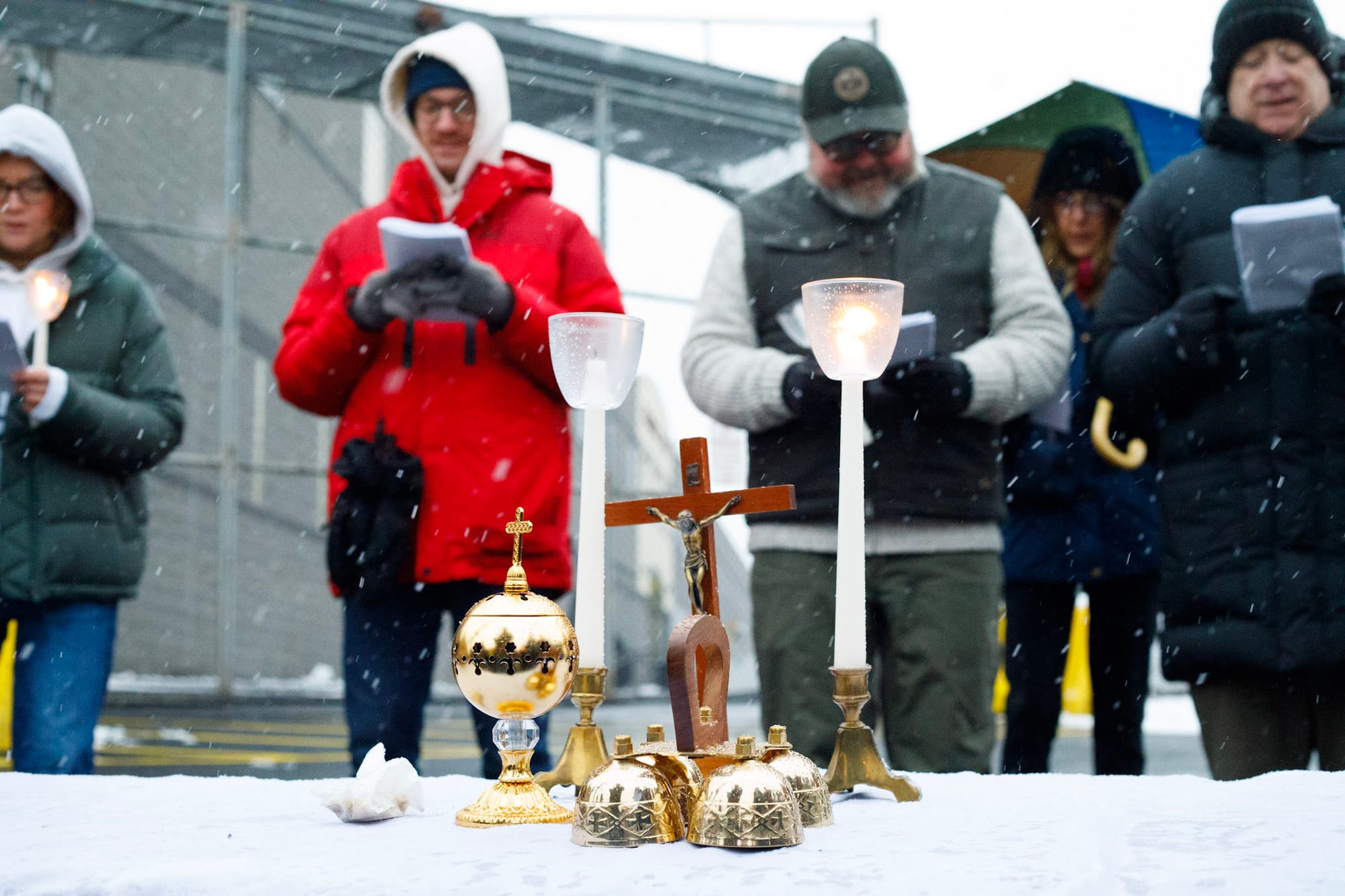
The New Personalist Movement was not alone in the sober vigil; dozens of fellow Catholics from the area had opted to brace the falling snow and bitter wind with us; Pax Christi, the Sisters of Charity, and two brothers from Our Lady of Mount Carmel among them. The crowd swelled into about forty people, circling around a section of concrete barrier that served as a makeshift shrine. Upon it, a wooden Christ hung on a simple cross with two candles flanking Him. Pamphlets with prayers and readings are distributed out, as are candles that constantly need to be relit. Our prayers floated above the howl of the wind, in one voice crying out to our God; the God of the poor, the God of the marginalized. The gray of the sky turned into a navy blue as we recalled each of his departed children. Each name was read with the accompanying chime of a bell. There were so many, the number underscored by a pause to add another name to the list; Víctor Manuel Díaz, whose death was announced hours earlier. Our hats, coats, and gloves were soaked by the end, crinkled pamphlets replaced with fresh ones that have become crinkled themselves.
It was pitch black and still snowing hard when I finally departed Newark. I left with the same bittersweet feeling that the previous departure had given me. It’s something, it causes the pain of others to ease somewhat for a time, but it does not physically free anyone from their confines. So much of our work rests upon hope. We leave with the hope those inside can hear us through the blacked out windows, that they can take some comfort in our prayers. That some of them know that they are not forgotten.
The following Saturday, VA nurse Alexander Pretti was executed by border patrol agents in the Minneapolis streets. The murder was committed in broad daylight, in front of a hundred cameras. Again, his killers were not charged. His death will not be the last at the hands of ICE.
Even now, the federal government continues to escalate, recently purchasing various warehouses across the country to transform them into high capacity ICE prisons. It has been reported that some of them will be able to hold up to 10,000 people. Their plans hold a bleak vision of the future; a myriad of bigger Delaney Halls, presided over by even more wardens whose main discontent comes from their long hours rather than the suffering they are paid to inflict, and more of their enforcer counterparts, who simply get off on the idea of spilling blood. Both will produce more Jean Wilson Brutus’s, more Renee Goods, and more Alex Prettis.
Christ promised his Apostles that the Gates of Hell would not prevail against his Church. He promised nothing for the United States of America. The nation has built the Gates of Hell and our representatives of both parties preside over them with corporate banality. All that we can do is push back against the inferno in whatever way we can.
Photography © John Gerry, @muteswanastoria on Instagram


